Nick Ferguson · IT Pro Direct · OpenAI DevDay 2026
I build practical AI systems for messy, evidence-heavy work.
Through IT Pro Direct, I work on AI implementation that preserves evidence,
keeps human judgment in control, respects security boundaries, and follows
through into workflows people can actually review and use.
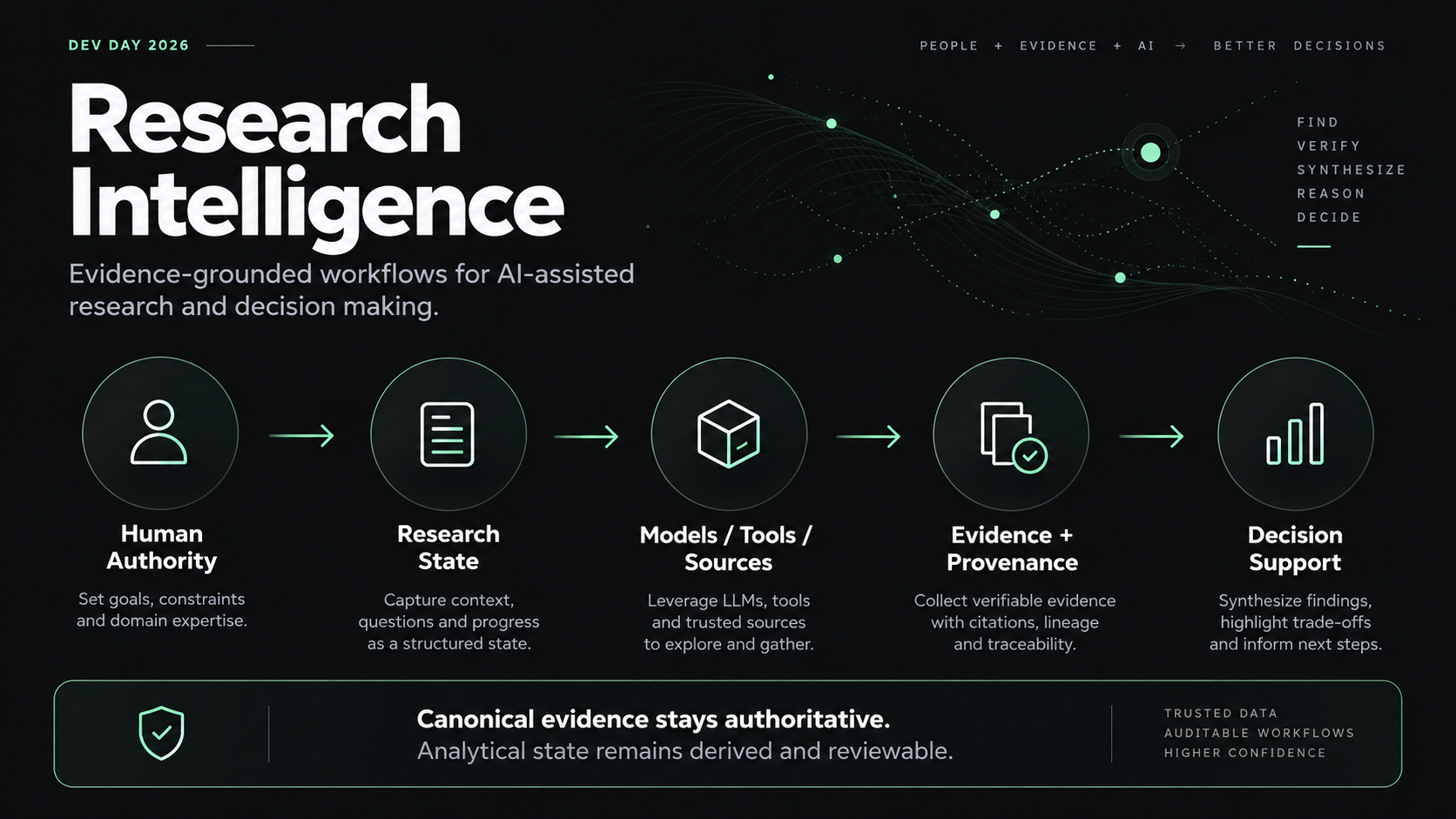
Evidence-grounded workflows for AI-assisted research and decision making.
Why it exists
The investigation can become harder to manage than the model.
In fast-moving AI-assisted research, evidence, uncertainty, failed paths,
decisions, and re-entry context accumulate quickly. A durable research state
helps keep the work inspectable.
The method
Canonical evidence stays authoritative.
Analytical state and model synthesis remain derived and reviewable. Provenance
travels with the work, uncertainty remains explicit, and human authority stays
at the consequential decision boundary.
A reviewable path from human intent to evidence-backed decision support—not an autonomous decision pipeline.
What the evidence currently supports
Two studies, mixed results, one durable operating lesson.
Study 001
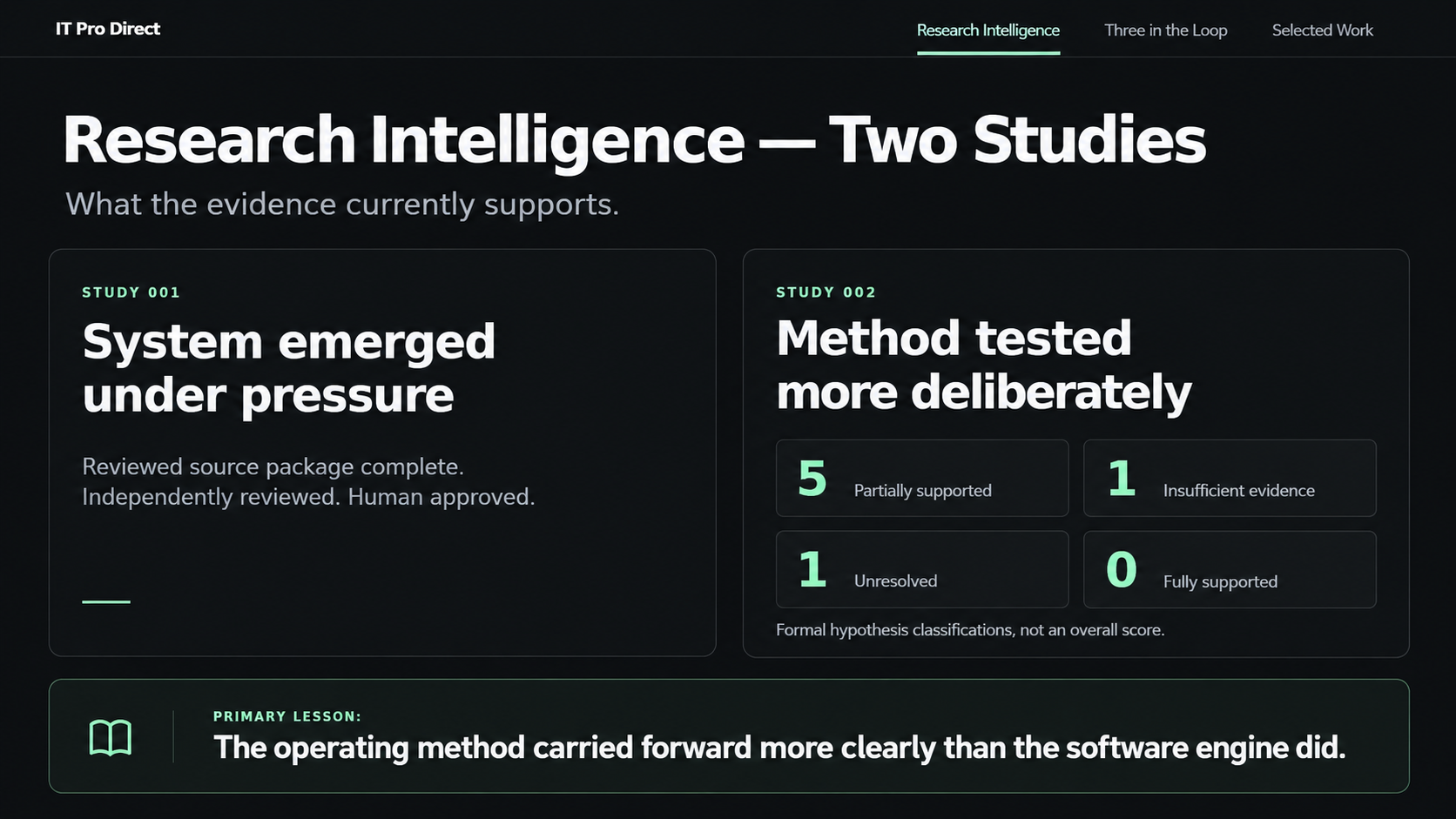
System emerged under pressure
A local analytical system grew alongside live model-behavior research.
The reviewed source package is complete, independently reviewed, and human approved.
Study 002
The method was tested more deliberately
Seven preregistered hypotheses closed with five partially supported,
one insufficient evidence, one unresolved, and zero fully supported results.
5Partially supported
1Insufficient evidence
1Unresolved
0Fully supported
Formal hypothesis classifications, not an overall score or success rate.
A visual summary of the reviewed evidence state; the classifications remain mixed by design.
Primary cross-study lesson
The operating method carried forward more clearly than the software engine did.
What is not claimed
The current evidence does not establish measured efficiency improvement,
causal performance gains, generalized transfer, team handoff, enterprise readiness,
or ROI. Those remain open questions rather than implied wins.
Supporting proof · Agentic systems
Three in the Loop
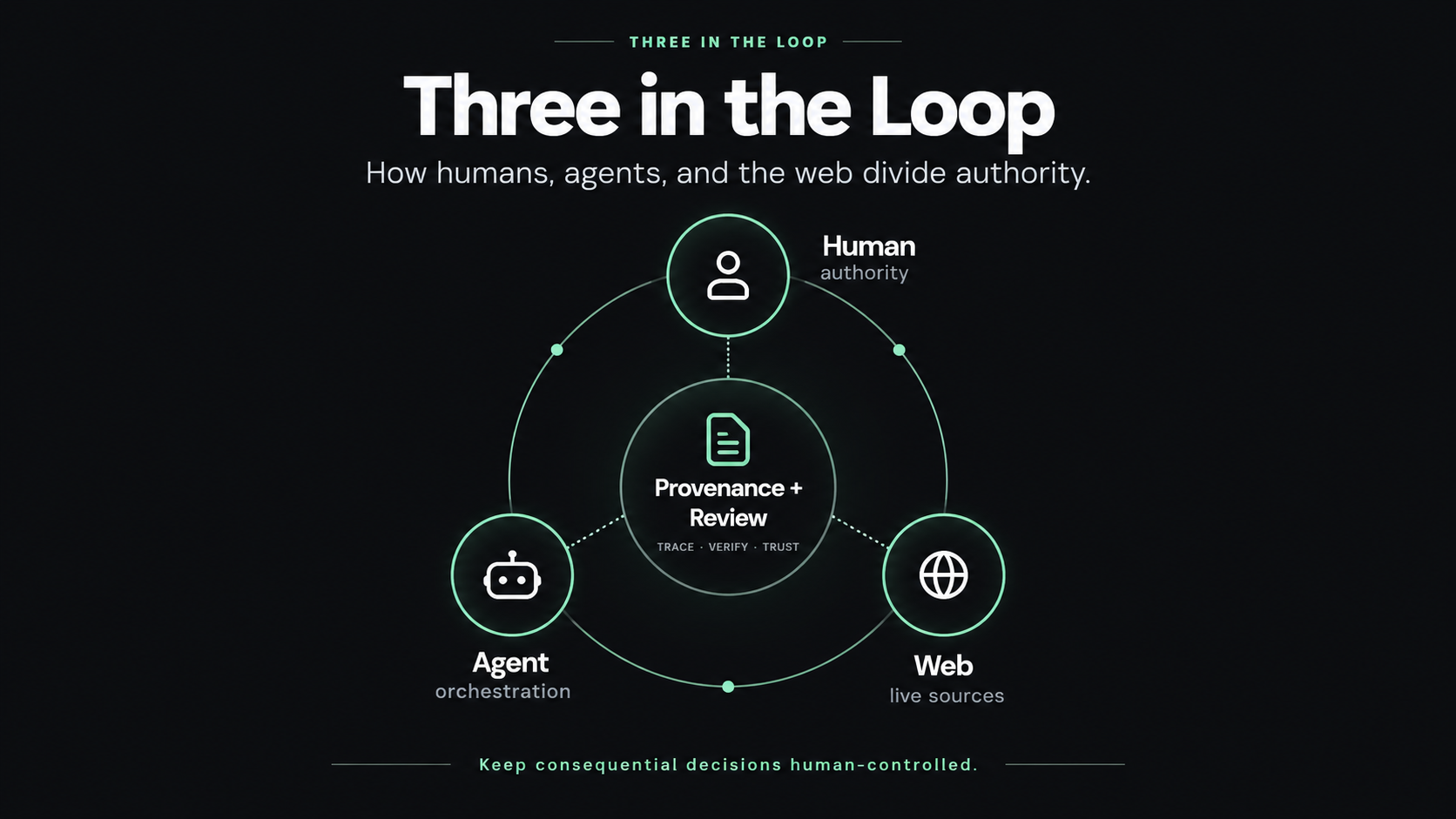
A WebMCP research workbench exploring how a human, an agent, and the live web
divide authority without losing provenance or review.
Human authority sets goals, constraints, and consequential decisions.
The agent orchestrates work while sources and provenance stay inspectable.
Review remains a system boundary, not a final-minute formality.
Authority is divided; provenance and human review connect the system.
Selected work · Practical implementation
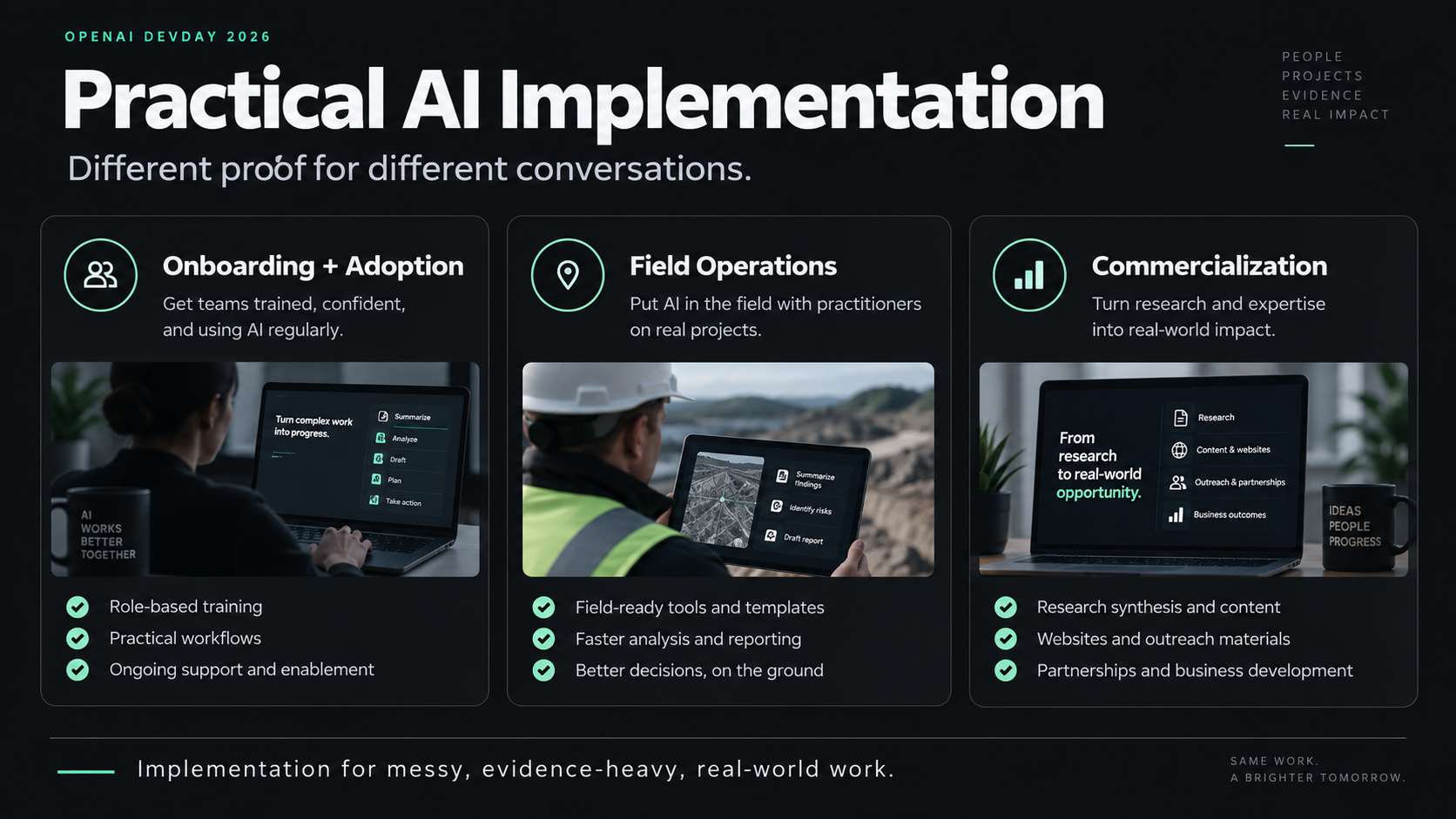
Different proof for different conversations.
The implementation identity stays consistent. The evidence changes with the
conversation—adoption, field operations, commercialization, research, security,
or agentic systems—and remains bounded by what can be verified and shared.
Concept illustration of implementation contexts—not evidence of measured outcomes, customer ROI, deployment scale, or partner status.
Ferguson · Approval-gated evidence
Real-world implementation context
Selected Ferguson-related work can provide a separate evidence track for
onboarding, practitioner workflows, and commercialization. Named-company claims
and artifacts stay withheld until approval, verification, and sanitization are complete.
Build Week · Completed product
My Crafted Career
A career decision-support product built during Build Week around a real
claims-career problem—useful proof of focused product execution, not a scale claim.
Security + systems · Technical depth
Evidence-aware technical work
Cybersecurity, cloud, network, evaluation, and operating-system projects add
the technical and security context required for responsible implementation work.
DevDay objective
Find where this capability is genuinely useful.
I’m interested in conversations with implementation teams, partners, builders,
and operators working through the gap between an impressive AI demo and a workflow
people can trust, use, review, and improve.